CARLO CHIESA, MILAN (ITALY)

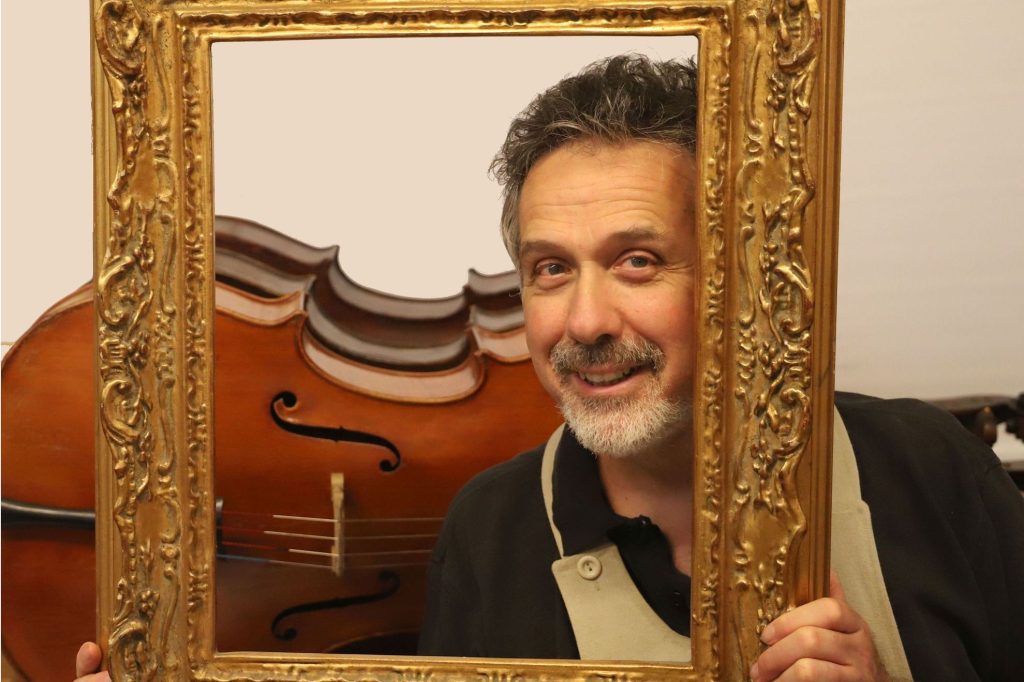
Carlo Chiesa, from Milan, builds and restores modern and baroque string instruments (violins, violas, and cellos, as well as viols) in collaboration with his son Tommaso. He pays particular attention to the fine-tuning and optimization of existing instruments, especially historical ones, working closely with musicians—famous and not—in the pursuit of the best possible sound for each instrument. Alongside his violin-making practice, he conducts research on ancient instruments and historical studies on various topics related to Italian makers and their techniques. He serves as curator of instruments for the Fondazione pro Canale.

A member of the International Association of Violin and Bow Makers (EILA), he has delivered lectures at numerous conferences and meetings of luthiers worldwide for professional organizations such as the French ALADFI (Association des Luthiers et Archetiers pour le Développement de la Facture Instrumentale), the American Federation of Violin and Bow Makers, the British Violin Making Association, the Violin Society of America, among others. He collaborates, or has collaborated, with institutions including the Museo del Violino in Cremona, the Galleria dell’Accademia in Florence, the Ashmolean Museum in Oxford, the Royal Academy of Music in London, the Library of Congress in Washington, Sapienza University of Rome, Politecnico di Milano, and the conservatories of Milan, Turin, and Como, among many others.

He has curated several exhibitions and catalogues of important violin-making displays in Cremona, such as …e furono liutai in Cremona (2000), Il DNA degli Amati (2006), Andrea Amati Opera Omnia (2007), Bottega Italiana (2013), as well as Antonio Stradivari (Stresa, 2003). He has also served on the scientific committees of these and numerous other historical violin-making exhibitions.

Co-author of Guarneri del Gesù (London, 1998) and L’Eredità di Stradivari (London, 1998), Carlo has published dozens of articles and studies in books and specialist journals, including The Strad and the VSA Journal. He has authored several entries on violin makers for the Dizionario Biografico degli Italiani of the Treccani Foundation, and edited/revised numerous entries (including Stradivari, Guarneri, Rugeri, Grancino, etc.) for the latest editions of the New Grove Dictionary of Music and Musicians and MGG (Die Musik in Geschichte und Gegenwart).

He has served multiple times as a judge in international violin-making competitions: in 2014 in Indianapolis for the Violin Society of America Competition, in 2021 for the Cremona Triennale Competition, and in 2025 for the Metelka International Violin-Making Competition in Prague.

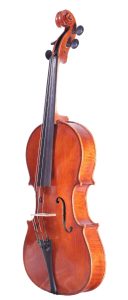
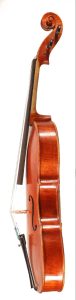
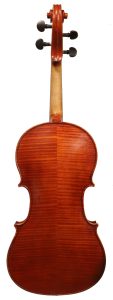
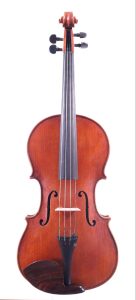
VIOLA mod. MAGGINI

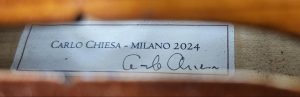
Year of construction: 2024
This instrument is inspired by a viola model used by the Brescian luthier Giovanni Paolo Maggini in the early 1600s, itself an evolution of a model by his master, Gasparo da Salò. Maggini’s original instruments are generally slightly larger in size, so the proportions have been faithfully replicated while reducing the measurements slightly.

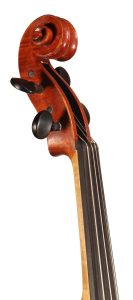
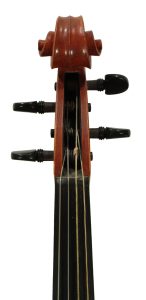
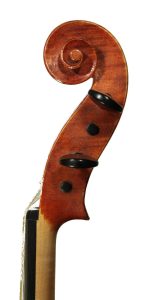
For the arching, the model and placement of the sound holes, as well as the overall appearance of the varnish and color, Maestro Chiesa sought to reproduce the Maggini originals he knows and has had the opportunity to study in depth. At the same time, he introduced certain personal features—such as the transparency and richness of the varnish—that he considers essential in his work. For the scroll, he adopted a classic Brescian model, while the pegbox follows the characteristic design connecting scroll and neck, commonly found in 16th-century Brescian violin making.

  • Top plate: two-piece, mirror-cut spruce, quarter-sawn, with medium-width straight grain

  • Back: two-piece, mirror-cut maple, quarter-sawn, with medium-width flame slanting towards the sides

  • Ribs: maple, with figure similar to the back and narrow grain

  • Scroll: maple, similar to the back

  • Varnish: oil-based, dark orange tending to brown, shaded at the edges

  • Main measurements:
    Body length: 41.5 cm
    Upper bout: 19.8 cm
    Middle bout: 13.5 cm
    Lower bout: 23.9 cm
TITLES AND RECOGNITIONS

Member of the International Association of Violin and Bow Makers (EILA).

Speaker at international violin-making conferences and meetings organized by professional associations, including ALADFI, the American Federation of Violin and Bow Makers, the British Violin Making Association, and the Violin Society of America.

Judge at international violin-making competitions:

  • Violin Society of America (Indianapolis, 2014)

  • Triennale Competition of Cremona (2021)

  • Metelka International Violin Making Competition, Prague (2025)

Curator and editor of catalogs for important violin-making exhibitions:

  • “…e furono liutai in Cremona” (2000)

  • Il DNA degli Amati (2006)

  • Andrea Amati Opera Omnia (2007)

  • Bottega Italiana (2013)

  • Antonio Stradivari (Stresa, 2003)

THE WORKSHOP OF CARLO CHIESA

Viale Certosa 45, Milan

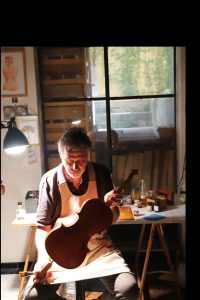
Carlo Chiesa’s violin-making workshop in Milan was established in 1990, when Carlo, at 28, decided to set up in his hometown and begin building new instruments, applying the skills acquired at violin-making school and refined through collaborations with various Masters in Italy and abroad.

Over time, interest in baroque instruments was added to the production of violins, violas, and cellos. The workshop became a sought-after center for viol players and musicians interested in performing on historically informed instruments, from Renaissance to Classical setups.

The workshop has trained numerous students from around the world, from Japan to the United States. Recently, the workshop has been revitalized by the arrival of Carlo’s son, Tommaso, who after formal training and periods of study in other Masters’ workshops, now works alongside his father in building new instruments and restoration projects.

DO YOU WANT TO LEARN MORE ABOUT CARLO CHIESA AND HIS INSTRUMENTS?

Discover all the luthiers in the network and their instruments

Privacy Policy | Cookie Policy